The Legacy Of Our Knowledge Society
Posted by Gary Myers on April 22, 2015

Knowledge mobilization (KMb) is making research useful to society. As such KMb is a process that enables social innovation. Social innovation stems from KMb initiatives between community and academia that is that lead to more far-reaching ideas and strategies.
“A Social Innovation is a novel solution to a social problem that is more effective, efficient, sustainable, or just than present solutions and for which the value created accrues primarily to society as a whole rather than private individuals.”
–Stanford University Centre for Social Innovation
A social innovation addresses the triple bottom line of economic, social and environmental impacts. All of humanity is affected by economic, social and environmental impacts – not just a few people in a few different countries in this world. Organizations like Social Innovation Generation (SIG: ; MaRS Discovery District; The Waterloo Institute for Social Innovation and Resilience and SIG@PLAN Institute) are working together to provide learning resources about creating conditions for social innovation.
Social innovation takes a systems approach to address social needs in an altruistic, collaborative and inclusive manner. Collaboration must occur among all sectors of society in order to create a fundamental shift in the development of social programs to cross the borders of societal gaps, create effective change and come closer to overcoming wicked problems. Sadly, the ongoing global struggle for human rights continues with each generation of our humanity and in each generation we perhaps come a few steps closer – and yet take so many unfortunate steps backwards – to become a better society and a better humanity.
In 1969 ARPANET (a military backed project within universities and the precursor to the Internet) established a link between the University of California, Los Angeles (UCLA) and the Stanford Research Institute. In 1989 Tim Berners-Lee, an independent contractor at the European Organization for Nuclear Research (CERN) proposed a large hypertext database with typed links to overcome the problems of information and data sharing over the Internet by physicists from around the world (leading to the creation of the world-wide-web). Stemming from a government funded military project within academia the Internet has now emerged as a knowledge mobilization platform for all of society to participate in sharing knowledge and making research useful to society.
The emergence of our knowledge society will be our era’s legacy as it transforms how government policy changes to address social needs and starts giving voice to all sectors of society to develop solutions within and by society – not just for society. Social innovation can lead to policy change that is more collaborative with all sectors of society at the systems level, and Canada’s toughest challenge facing systems issues are our health system; our food supply; the future of learning and work; and the future of government structures.
Today knowledge mobilization provides opportunities for social innovation to emerge and address such systems level challenges. This important connection must be properly understood for social innovation to be implemented and for research to have any lasting impact.
As our younger generation begins the journey of their future – now perhaps as graduate students seeking through their own research to make a difference in our world and add to our knowledge society – what legacy do you expect to build and give to the next generation after the legacy of our knowledge society emerges into the legacy beyond?
Uncategorized
Passion About Research By Knowledge Mobilization
Posted by Gary Myers on April 5, 2015
 KMbeing

This is a follow up to my earlier blog post about why should researchers blog & tweet. I could continue listing the usual “tips and reasons” to set researchers on their way. However, I want to follow up to my previous blog with something essential that I forgot to mention – the most important tip and underlying reason that sets the tone for blogging and using twitter over anything else:
If you’re not interested in your own research and how it can benefit others you will never be interested in blogging or tweeting about it!
Researchers become interested in a particular field of study for a reason. Research is about presenting data that initially stems from some personal curiosity or experience. Academic writing stems from wanting to find out more, understand more and educate others about a particular phenomenon that stimulates this initial curiosity or explains personal experiences – and…
View original post 526 more words
Uncategorized
Posted by Gary Myers on March 22, 2015

There’s a 1988 song by the band Mike and The Mechanics called that begins with “Every generation blames the one before, and all of their frustrations come beating on your door…we all talk a different language talking in defense.” Although this song addresses a son’s regret about not expressing to his father the things he wishes he would have said when his father was still alive, the opening lines reflect an inter-generational view that holds meaning for many.
I write this blog post from a more personal than usual perspective – a mid-life perspective that some may relate to and others not so much, depending upon which generation of “X” “Y” “Z” or “millennial” group you are lumped into. Regardless of when you were born I hope you will consider these words as a message reaching out to all generations. I am considered a tail-end “baby-boomer”. Born in 1964, I may now be called a “zoomer” or aging “boomer” who still has zing. Inter-generational tension seems to exist regardless of which part of the past two centuries you were born. History reflects a momentum of building upon (or criticizing) the generation that was born before – or after – you were born.
As I grow older – closer to retirement than to the idealism of my twenties – I realize that perspective is everything! But it’s not just about my own “older” perspective, it’s also about being open to the perspective of any generation. And being open means not talking in defense. Our perspective is our own reality.
Each week I write about knowledge mobilization. I firmly believe that by exchanging our knowledge across the boundaries of age, gender, ability, race, culture, nationality, religion or sexual orientation we can come closer to understanding each other and learn from each other to make the world a better place. Problems occur when we dig our heals in and refuse to be open because of ideology, faith, extremism, or a sense of entitlement or lack of fairness (As a friend of mine likes to say, “life isn’t fair so build a bridge and get over it!”). All of these are dichotomies that have and still polarize us in our world today – that do not focus on the underlying understanding of our common humanity. One need only look at current news in the media to see the continuing presence of such dichotomies.
Although I choose not to speak publically as an employee about the York University and University of Toronto labour disruptions (as a former colleague who worked with me at York’s Faculty of Graduate Studies has done in a recent blog post) events such as these are clear examples of when people take a dichotomous “us” and “them” mentality. Pointing fingers and saying “they can” or “they should” don’t help such situations – it only inflames them further.
I grew up in a low-income family and never had the opportunity to finish an undergraduate degree until I was in my forties – after much hard work, jobs with minimum wages, no health or insurance benefits, attending classes while working full time – with years of sacrifice. It wasn’t due to a lack of intelligence, but to various circumstances in my life. So I know something about precarity. I worked many years in the hospitality industry, made a choice to change careers to work in the academic world, and continued to work hard to finally make that change a current reality. It seems far too many people today expect immediate gratification and seek possessions, technologies, money, careers, benefits, and higher education as some automatic entitlement or right.
Each one of us lives our lives, experiences challenges (some more difficult than others) and we either learn to pull through or we don’t. Along the way there are those kind human beings who try to lend a hand for those more in need – and there are also those more selfish human beings who really don’t care. This is the ultimate and only dichotomy that counts. (It’s also why I consider knowledge mobilization important to overcome hatred in our world). Ask any person from any generation if they know someone from their own generation with either a kind approach or a hateful approach to our fellow human beings and you will certainly find the answer is yes in any generation. Then ask yourself, which side do you fall on?
From a broader human perspective – our main goal should be to increase every person’s well-being and quality of life, but sadly, we don’t. Because we still point our fingers and say “they can” or “they should”.
But is it our right to expect such kindness from other human beings. No.
This is also the challenge of our living together on this planet.
Do I expect people to be kind? Hopefully – but never certainly. This happens regardless of generation.
After basic needs are covered, everybody has the right to pursue other goals in life: happiness, wealth, careers, and knowledge – including higher education, but they must all be understood from an individual’s subjective perspective.
Many societies attempt to increase the well-being and quality of life of their citizens to create greater inclusion and harmony of living. My interest in knowledge mobilization is based upon this very ability to bring together policy-makers, practitioners and researchers from public, private and non-profit organizations – in a civilized, inclusive, and non-accusatory manner – to create sustainable solutions to challenges such as poverty, social exclusion, discrimination and other problems that create suffering and disparity within society
While basic education is necessary and a human right for children to learn and develop social skills; and secondary school education is required to focus on developing professional skills; higher education is an opportunity, a privilege and a choice which aims at providing specific knowledge for advancement in various fields. Higher education is not a human right – it is a purely personal choice.
Problems occur when one conflates the choice of pursuing higher education with the opportunity to be paid for work while doing so. The reality is that there is a choice between pursuing a higher education and working in a job to make a living wage. Not recognizing this reality is abdicating one’s own power to enact personal change through personal choice – and with choice comes responsibility.
Most importantly, remember – tomorrow is promised to no one.
Communications, Individual Knowledge Mobilization, KMb, knowledge, knowledge exchange, knowledge mobilization, knowledge translation, making the world a better place, policy, research, social collaboration, Uncategorized, university being open, blame, CUPE 3903, defense, discrimination, education, Faculty of Graduate Studies, frustrations, generations, harmony, hatred, higher education, History, human rights, idealism, In The Living Years, knowledge mobilization, labour disruption, living together, Mike and The Mechanics, open-minded, opposition, perspective, poverty, social exclusion, strike, war, York University
Posted by Gary Myers on March 14, 2015


Sometimes missing conferences can’t be helped. Such is the case with two conferences this year – the 2nd annual in Edinburgh, Scotland (13-14 April, 2015); and the 4th annual taking place this year in Montreal, Quebec (14-15 May, 2015). Despite the advance planning and my previous attendance and support, I just cannot make it to these conferences this year due to my new job at the Faculty of Graduate Studies and work commitments involved.
Although I am disappointed that I can’t attend, I wholeheartedly encourage anyone interested in learning about enhancing knowledge exchange or knowledge mobilization practice – including graduate students thinking about putting current or future research into practice with impact – to register and go.
You can be sure that I will be spending some time assessing what activities took place. For previous events, I have blogged about the UK KMb Forum here and here; the Cdn KMb Forum here and here; tweeted about the UK Forum , , and , and the Cdn Forum , and , including participating in a Speakers Corner . I even wrote two reports for the previous Canadian KMb Forums – 2013 Cdn KMb Forum Report; 2014 Cdn KMb Forum Report. (Link here to see more about the ).
I’m sure someone else will be taking notes this year on the presentations and discussions of topics and outcomes of conversations for a report, and I look forward to reviewing what transpired. I’m also looking forward to following up with the amazing organizers (UK KMb Forum) and Peter Levesque (Cdn KMb Forum), and I hope to be involved again at future events.
So why should you attend (again – or for the first time) either or both of these KMb Forums? The UK and the Canadian KMb Forums are a continuum of engaged relationships that have developed out of previous events, and an opportunity to develop new partnerships and valuable multi-sector and international connections.
Last year’s participants at the inaugural UK KMb Forum, included a mix of individuals from government policy, economics and evaluation, health research, youth & criminal justice, cancer research, social investment, women’s health, prison & corrections, freelance writing, science, non-governmental organizations, knowledge management, families & relationships, pharmacy, along with a variety of university scholars, administrators and community organizations – an incredibly successful session that brought together a wide range of knowledge exchange all in one place at one event! I heard someone say that they had not heard of any other multi-sector conference like this ever taking place in the UK, as events always seem to be so “specialized” and discipline-specific.
Extending on last year’s theme of Making Connections Matter, the 2015 UK KMb Forum focuses on four key areas of such connections:
- Making Connections Matter: Knowledge Producers – helping researchers connect with those who help turn research into practice and impact beyond just publication
- Making Connections Matter: Knowledge Brokers – providing opportunities for brokers to share their learning and lived experiences with other brokers and a wider audience
- Making Connections Matter: People Who Use Knowledge – enabling practitioners from a wide range of sectors to meet academics, researchers and policy makers
- Making Connections Matter: People Who Want To See Knowledge Used – giving public service, third sector and industry workers a chance to tell their own stories to influence future research
Last year’s Canadian KMb Forum was also another successful interdisciplinary conference with attendees from a mix of sectors including health, academia, children & youth services, workplace safety, environment, addictions & mental health, education, disability services, business, agriculture, and childhood development. The theme of the 2015 Canadian KMb Forum is Creativity as Practice: Mobilizing Diverse Ways of Thinking. This year’s Canadian KMb Forum will emphasize how creativity is a necessary part of knowledge mobilization practice in order to build capacity and improvement for knowledge mobilization by engaging with researchers, practitioners, knowledge brokers, community members and policy makers in more creative ways to enable partnerships and collaboration.
Even though I can’t attend either of these valuable knowledge mobilization forums this year – if you’re interested in effective ways of exchanging knowledge and helping to make research useful to society you can be part of one or both of these important events that bring people together locally, nationally and internationally to establish connections and form new relationships that I have found continue to influence my own work in very important ways.
And of course, you may even get a chance to see !
graduate students, KMb, knowledge, knowledge brokers, knowledge exchange, knowledge mobilization, knowledge translation, making the world a better place, research, social collaboration benefit, Canadian Knowledge Mobilization Forum, Cathy Howe, collaboration, community, conference, connections, diversity, global knowledge, helping others, individual experience, individual knowledge, KMb, knowledge connections, knowledge creation, knowledge differences, knowledge diversity, knowledge exchange, knowledge mobilization, knowledge sharing, knowledge value, making the world a better place, new knowledge, Peter Levesque, research, sharing knowledge, social benefit, The Canadian Knowledge Mobilization Forum, thinking, UK Knowledge Mobilisation Forum
The Politics of Austerity, Research & Knowledge Mobilization
Posted by Gary Myers on March 1, 2015

Knowledge mobilization (KMb) is slowly emerging as a process to connect academic research with evidence-based policy-making since the emergence of KMb over the past decade. KMb was cultivated in earlier forms of evidence-based practice, and recent initiatives across sectors of public administration indicate a move towards creating new policies based on research that produces social benefit as an impact. (For more in-depth reading on the historical development of KMb, I continue to recommend an excellent longitudinal analysis paper written by Carole Estabrooks and colleagues that traces the historical development of the knowledge exchange field between 1945 and 2005 with an author co-citation analysis of over 5,000 scholarly articles).
The term knowledge mobilization (KMb) evolved following the publication of an evaluation report of the Community-University Research Alliance (CURA) program of the Social Sciences and Humanities Research Council of Canada (SSHRC) in 2004. This led SSHRC to create a division of Knowledge Products and Mobilization to enhance and accelerate the movement of research findings into policy and program development.
However, the politics of austerity continues to affect the types of research deemed more beneficial than others. In terms of research, austerity describes government policies used to reduce research funding as part of maintaining government budgets. The effects of austerity measures on research by decreased funding is seen as direct attacks on public services, whose primary mission is to reduce social inequalities – which social science research, in particular, seeks to address and understand.
Is it because of this obvious link – and full-circle connection – between social science research and public services that politicians wish to ignore when they implement austerity measures that leads to a decrease in research funding?
Research funding and policy are politically guided and frequently challenged as a means to deliver public services due to a growing disconnect over the past decade between researchers and the Canadian government. The current Conservative Prime Minister Stephen Harper came to power in 2006 – two years after SSHRC’s CURA evaluation and KMb momentum began. Since then, many Canadian researchers and knowledge brokers have gained an international reputation for broadening the research path based on the development of KMb; however Canada’s government has also gained an international reputation for ignoring KMb recommendations and silencing scientific experts who seek to make their work public – causing a rift in the relationship between academia and government. (Further articles on Conservative government cuts to science research can be found here and here and here).
In an effort to reduce government spending, many researchers have been affected by a decrease in research funding. The ongoing transformation of the academic sector has been most apparent with the many challenges created by financial struggles with universities seeking evidence-based reform with initiatives such as the Research Excellence Framework (REF) in the UK or a such as Academic and Administrative Program Review (AAPR) in Canada. There has been increased pressure on universities for financial income and resources along with increased pressure from government granting agencies that expect a valuable public and/or private return of investment for providing research funding.
Considering the continuing decrease in research funding, should researchers (particularly social science researchers) wish to maintain a prominent role in the pursuit of research for social benefit they need to develop broader partnerships – with the use of knowledge brokers – to not only advance wider knowledge networks and broader connections for research, but also establish collective lobbying voices for government policy change.
But first, researchers must understand that integrating KMb strategies into their own research plays a crucial role in creating these connections of influence. KMb must start as an institutional capacity that involves public, private and community sector partners. Then, by incorporating a social media element, the connections, conversations and collaboration aspects of social media work together to help establish Communities of Practice online and can support the social and influential nature of KMb on public policy. These vital links of KMb are illustrated in Applying Social Sciences Research for Public Benefit Using Knowledge Mobilization and Social Media. Governmental, corporate, academic and community partners need to intersect and work together to help research organizations and society reorient themselves.
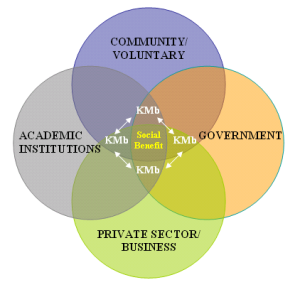
Researchers alone are incapable of influencing political strategies that continue to decrease funding. This requires a movement through broader partnerships that can serve as a collective point of community engagement and pressure politicians to increase research funding and lead to policy change.
The Conservative government’s political agenda in Canada remains largely unabated as policy makers decide which resources Canadian researchers (and society) “needs” to be allocated for the next big political game. Changing this will require a cooperative movement that transcends individual academic, corporate and community sectors to make political demands and build the social-benefit capacity of research that has been historically entrenched in university/institutions which requires further continuing expansion to society beyond. Without a strong KMb strategy, deeply rooted in community-engagement and forging new partnerships to lobby government for increasing funding, it would appear that the under-funding of research from government sources will continue.
Canadian researchers (particularly social science researchers) face an historic opportunity with an upcoming Federal election on October 19th, 2015 which may well change the Conservative precedent of decreasing Federal research funding in Canada. Future research depends on the extent of decreasing the financial pressures that continue to be based on the politics of austerity that overlook the social benefits of research.
Community of Practice (CoP), government policy, Individual Knowledge Mobilization, KMb, knowledge, knowledge brokers, knowledge exchange, knowledge mobilization, knowledge translation, making the world a better place, policy, research, social collaboration, social media, social media tools, university Academic and Administrative Review AAPR, Applying Social Sciences Research for Public Benefit Using Knowledge Mobilization and Social Media, austerity, Canada, Canadian Federal election, Carole Estabrooks, government, KMb, knowledge brokers, knowledge mobilization, politics, Program Prioritization Process PPP, research, Research Excellence Framework REF, social media, Social Sciences and Humanities Research Council SSHRC, Stephen Harper
Posted by Gary Myers on February 22, 2015

Universities face financial challenges in maintaining institutional and academic success while also seeking solutions to fulfill public accountability for a return on investment. According to the Association of Universities and Colleges of Canada (AUCC) there are 1.2 million students in degree programs in Canada with 42,000 full-time professors. Universities are a $30-billion dollar enterprise (including faculty/staff salaries, buildings/maintenance, supplies and other infrastructure) – with $10-billion worth of research activities. Approximately $2.5-billion of research funding comes from federally-funded granting agencies such as the Social Science and Humanities Research Council (SSHRC), Natural Sciences and Engineering Research Council of Canada (NSERC), and the Canadian Institutes of Health Research (CIHR) – while the remaining $7.5-billion comes from institutional investments and other sources such as industry, other government-funding and donations.
To break this down further, The Council of Ministers of Education, Canada (CMEC) reports that Federal, Provincial, Territorial and Municipal funding – including funding for research – accounts for approximately 55% of revenue; student fees account for only 20% of revenue; and bequests, donations, non-governmental grants, sales of products and services, and investments bring in 25%.
Despite these revenue sources, universities continue to struggle to overcome an economic crisis which has been driven by balancing institutional/labour costs and sustaining or increasing student enrolment. Maintaining fiscal feasibility is a crucial challenge for the future of Canadian universities as universities have recently been faced with a decrease in funding (specifically in real dollars) – particularly federal funding from Canada’s Tri-Councils.
Granting Councils SSHRC, NSERC and CIHR Base Funding 2007-2014:
|
|
|
|
|
|
|
|
|
Change |
|
|
|
2007-08 |
2008-09 |
2009-10 |
2010-11 |
2011-12 |
2012-13 |
2013-14 |
(2007-14) |
|
|
|
|
|
|
|
|
|
|
|
|
|
SSHRC |
383.7 |
358.1 |
368.1 |
359.4 |
355.6 |
351.5 |
344.8 |
-10.10% |
|
|
NSERC |
1057.9 |
1051.5 |
1042.3 |
1050.2 |
1030.8 |
1018.9 |
990.3 |
-6.40% |
|
|
CIHR |
1017.8 |
989.8 |
1020.1 |
1026.9 |
953 |
969.4 |
941.4 |
-7.50% |
|
|
Indirect Costs |
327.9 |
335.7 |
330.9 |
324.9 |
322.6 |
318.9 |
302 |
-7.90% |
|
|
|
|
|
|
|
|
|
|
|
|
|
|
|
|
|
|
|
|
|
|
|
|
TOTAL |
2787.2 |
2735.0 |
2761.5 |
2761.4 |
2662.1 |
2658.7 |
2578.4 |
-7.50% |
|
|
|
|
|
|
|
|
|
|
|
|
|
Source: SSHRC, NSERC and CIHR Departmental Performance Reports, Budget 2012 and Budget 2013 |
|
|
|
|
|
|
|
|
|
|
|
|
What this means is that universities continue to place reliance on government funding – yet funding continues to decrease each year.
What this also means at the same time is that there is great potential for universities (Canadian or otherwise) through opportunities provided by new forms of innovation through private-sector and community-engagement.
Supporting inclusive, innovative and responsive universities is a prerequisite for sustainable institutional and academic quality and success.
The emergence of knowledge mobilization as a priority embedded in university planning, the changing approach to research as more inclusive of community partners and other key stakeholders, and the need for more innovation call for a renewed understanding of the rapidly changing academic world.
This understanding is reinforced by greater interdisciplinary approaches within various academic programs – including such areas as Critical Disability Studies and Technology/Communications Studies. University policies need to continue to recognize the value of interdisciplinary approaches while dealing with the economic challenges to improve knowledge exchange about how our modern universities now work.
University research and innovation can address many social issues and challenges. Research that incorporates knowledge mobilization strategies can explore new forms of innovation and strengthen the evidence-base for broader application and other relevant professional practice, social services and public policies.
Such research that promotes clear and effective community-campus cooperation can create new ideas, strategies and policy structures for overcoming a financial crisis by creating a growth agenda in research that focuses on knowledge mobilization integration and the promotion of emerging technologies and entrepreneurial-skills investments by current and future students.
A new generation of students – dubbed by Maclean’s magazine as “Generation Z” – appears to be more socially engaged than students in the past and these students are more apt to have more social and entrepreneurial instincts. These students are more innovative and inclusive by being more socially and entrepreneurially engaged. The effects of harnessing and focusing this approach into cooperative research and innovation for community-campus partnerships requires universities to also adjust to a new approach to university research and financial sustainability.
In short – this new university paradigm of research needs to foster a greater understanding of academic funding that may be less reliant on government sources by providing solutions that support inclusive, innovative and responsive partnerships with more community and private stakeholders in the context of unprecedented academic transformations and shifting academic priorities.
KMb, knowledge, knowledge exchange, knowledge mobilization, knowledge translation, making the world a better place, policy, research, social collaboration, university academic, Association of Universities and Colleges of Canada, AUCC, Canada, Canadian Institutes of Health Research, CIHR, CMEC, community university, entrepreneur, financial, funding, Generation Z, government funding, innovation, investments, knowledge mobilization, Maclean's magazine, Natural Sciences and Engineering Research Council, NSERC, research, revenue, Social Science and Humanities Research Council, SSHRC, The Council of Ministers of Education, Tri-Councils, university
Posted by Gary Myers on February 16, 2015

What is innovation? Is it simply coming up with a new idea; is it creating a new design or product; is it developing a new process?
In research terms, innovation is essentially linked to improvements in the application of knowledge towards advancements in science and technology. Knowledge mobilization is making research useful to society. As such, knowledge mobilization is a process that enables innovation that stems from research initiatives between community and academia that is that lead to more far-reaching ideas and strategies.
According to Stanford University Centre for Social Innovation:
“A social innovation is a novel solution to a social problem that is more effective, efficient, sustainable, or just than present solutions for which the value created accrues primarily to society as a whole rather than private individuals.”
defines innovation as:
“A process through which economic or social value is extracted from knowledge—through the creating, diffusing, and transforming of ideas—to produce new or improved products, services, processes, strategies, or capabilities.”
Despite the emerging influence of Canada in the knowledge mobilization field over the past decade, and the impact that university research has had by becoming more accessible and receptive to community partners – still show that Canada remains near the bottom of countries with the highest development of successful innovation strategies.
While examples of Canada’s success in the knowledge mobilization field can be seen through the great collaborative work of a pan-university network such as ResearchImpact, why is there still a disconnect with greater successful innovation despite historic investments in Canadian research and development through knowledge mobilization?
Perhaps the answer is in the lack of initiative of the private-sector in working more closely with the public-sector as evidenced by the disappointing grades given to Business Enterprise R&D spending (“D”) compared to Public R&D spending (“B”).
Another key message put forth by the Conference Board of Canada is that Canada must perform at the cutting edge and attract the brightest students to careers in science and engineering or it will continue to fall behind our peers on this indicator.
In these particular areas, York University – part of the ResearchImpact network – continues to lead the way through its knowledge mobilization initiatives creating greater innovation by offering opportunities for graduate students to work more closely with business through research-funders like , York’s entrepreneurship program Launch YU, and business mentoring with ventureLAB.
York University has also recently opened the Lassonde School of Engineering which was established, in the words of its Dean, Janusz Kozinsi, “to educate (a) new type of engineer — someone with an entrepreneurial spirit, a social conscience and a sense of global citizenship who is a highly-trained professional in their field and across many disciplines.”
Today, knowledge mobilization provides opportunities for innovation to continue to emerge and address the challenge of improving Canada’s performance on the innovation stage. We may still have a way to go on an international level to compete against other countries for more successful innovation; yet on a Canadian level York University is a clear example of taking the right steps to providing opportunities for future innovators such as graduate students – an example worth following to not only increase the academic grade but also the innovation grade.
graduate students, Individual Knowledge Mobilization, KMb, knowledge, knowledge exchange, knowledge mobilization, knowledge translation, making the world a better place, research, social collaboration academic, business enterprise, community engagement, entrepreneur, global citizenship, graduate students, innovation, Janusz Kozinsi, knowledge mobilization, Lassonde School of Engineering, Launch YU, Mitacs, partnerships, professional, public spending, research and development, ResearchImpact, social innovation, Stanford University, The Conference Board of Canada, university, ventureLab, York University
What Is Research “Success”?
Posted by Gary Myers on February 8, 2015

Every day when we read or listen to the news on the radio, television or on our digital devices there are reports of poverty, homelessness, hatred, crime, violence, or wars. Many in this world are not safe, secure or educated – and despite advances in modern technologies that create broader knowledge exchange (more people are much more aware of what’s happening around the world than any other generation before us) we are still faced with wicked problems that continue to plague us.
Although knowledge mobilization has contributed to making research useful to society, we are still faced with the challenges of healing our social problems to bring about broader peace and happiness worldwide. As someone who has written about the value and benefits of incorporating knowledge mobilization strategies by researchers – particularly social science researchers – to contribute to improving our human experience, I recognize that basic human problems like fear, suffering, ignorance, prejudice, bigotry and discrimination still exist.
I know many people who share my concern about the many difficult social conditions that we still face on this planet and those who also share in my hopes that knowledge exchange has greater value when applied on a worldwide scale. As a humanist, I strongly feel that global knowledge mobilization is necessary to overcome wicked problems – but as I’ve stated in previous blogs, knowledge mobilization without compassion, without being motivated by kindness, without seeking benefit beyond our own communities is extremely limited.
Each person, whether researcher, practitioner, community member or policymaker has a responsibility to exchange our knowledge to benefit all human beings – by thinking about ways to scale up the research benefits gained at our local levels.
When individuals choose to hate and fight each other or discriminate based on opposing ideologies, selfish gains or ignorance, there is a common human imperative that calls us to change such limiting knowledge. Our common humanity implores us to find solutions through cooperative knowledge exchange as a fundamental objective.
Researchers have a particular responsibility inherent as scientists to influence change for global benefit by working with community members to inform policy. If we understand the causes of problems that continue to hold us back globally without gaining cooperation through knowledge exchange – research remains limited and – on a broader-scale – practically useless.
Whether we think so or not – human suffering inflicted not by physical illness but by other humans is the worst human illness that continues to affect all of us. We spend billions of research dollars to rightly find cures for physical illness – but let’s not forget to also focus research resources on curing our more general human illness of wicked problems.
Every researcher hopes to achieve “success” from their research. But what is research “success”?
- Is “success” limited to finishing a graduate degree as a Masters or PhD student?
- Is “success” limited to publishing peer-reviewed papers in academic journals?
- Is “success” limited to inspiring other future researchers to carry on finding a cure?
What if researchers thought beyond limited “success” to the ultimate success in research? In the quest for “success” in research, researchers have used different methods – sometimes even unbecoming in their status as scientists – for their own self-centred gains. Ultimately, when research becomes short-sighted without a broader perspective of benefit beyond the academy – global problems will continue to exist.
Over the past decade, the development of knowledge mobilization has helped bring researchers, practitioners, community members and policymakers closer together – not just locally, but internationally. Broader community engagement results in greater research impact by creating more global knowledge exchange for social benefit. Many researchers are no longer as siloed in their disciplines and research interests as they once were. Old-school research was very much dependent upon the research being done by researchers in one particular field of study. New-paradigm research is now more interdisciplinary and community-engaged. Today, research – through knowledge mobilization – has made academia more closely interconnected with and inclusive of community.
Without a sense of scaling-up this new-paradigm of research we cannot expect to overcome our global problems. Too much depends upon continuing to shift our research perspectives to pursue only one’s own research interests without considering how to also apply this research on a broader-scale. If researchers continue to approach problems considering only temporary gains, research may continue to perpetuate itself – but will always remain limited.
I’ve said it before and I’ll continue to say it again, researchers who connect the intellect of their minds with the development of a kind heart make the best knowledge mobilizers. When we embrace knowledge mobilization for social benefit with both brains and heart, with both thinking and action there is an opportunity to reinvent our ideas of knowledge to ultimately make the world a better place for everyone.
World conflicts and wicked problems that persist globally continue due to a failure to remember our common humanity. An answer to address these concerns is doing research with both intelligence and compassion. It’s time for researchers to transcend our usual research methods and regard research as a responsibility to benefit individuals, communities, nations and the world together.
To improve research globally in the world, I continue to encourage researchers to adopt knowledge mobilization strategies that can make considerable contributions to social benefit internationally – and focus research on addressing the wicked problems that still continue to plague us. The ultimate research “success” is about doing research that gives global humanity precedence – and knowledge mobilization has a large role to play in this process. In order to solve our human problems globally we must challenge current researchers and develop future researchers to combine their interests with those of our common humanity.
In the new-paradigm of research perhaps global knowledge mobilization will help overcome the wicked problems that continue to exist and new researchers will take on the challenge of doing research for greater social benefit worldwide.
graduate students, Individual Knowledge Mobilization, KMb, knowledge, knowledge exchange, knowledge mobilization, policy, research, social collaboration academia, benefit, community, crime, global conflict, graduate students, hatred, homelessness, humanity, kindness, knowledge exchange, knowledge mobilization, policy makers, poverty, researchers, social science, success, violence, war, wicked problems
21st Century Research: Interdisciplinary Scholarship & The Third Sector
Posted by Gary Myers on January 31, 2015

Researchers in the 21st century must now think about and become interested in cross-disciplinary and inter-disciplinary connections. Cross-sector and interdisciplinary scholarship are exactly what knowledge mobilization (KMb) is about – researchers networking across borders as an essential element of the research process to provide greater outreach and input for social benefit to make research useful to society. Although knowledge mobilization can be a part of any academic discipline – it’s particularly true for social science and humanities research.
Research is no longer valued if it’s locked up in disciplinary silos or peer-reviewed journals. Research must now involve open-access cross-pollination with other sectors in academia and community that informs and is informed by policy-makers – taking place across a variety of organizational, public, business and government spaces.
Community is not just community-based researchers or practitioners. Community is also about what is often called the third sector – the sphere of social activity undertaken by voluntary organizations and public citizens that are not-for-profit and non-governmental. By including the third sector in the interdisciplinary border crossings without boundaries is a more inclusive and extensive way of being a boundary-spanner.
Being a boundary-spanner begins right at the beginning of any research career as graduate students embark on a future in research – as I wrote about in an earlier blog post. Graduate students have an excellent opportunity to initiate such connections by considering how their own research can have impact within the third sector, or even how they can become involved in the volunteer-sector while doing their own research. And many are already volunteering with recent statistics about volunteering in Canada showing 15-24 year olds representing the highest percentage of volunteers at 58%, and 35-44 year olds at a close second at 54%.
The idea of being a boundary-spanner is also what lead me to develop the Myers Model of Knowledge Mobilization.
The greatest advances often occur not exclusively in academia, or private-sector practitioners or business leaders or because of government policies. The greatest advances and social benefit often occur at the intersections and collaborations between borders and boundaries – an important message for anyone in research or also beginning a career in research.
By promoting knowledge mobilization on a broader scale, ResearchImpact has been playing a leading role in cross-sector connections since 2006. ResearchImpact is a knowledge mobilization network of 11 Canadian universities involved in community-university engagement to inform public policy, involve non-profits in the research process and create valuable social change. ResearchImpact has crossed university borders into communities to include all sectors – public, private and non-profit, and has given graduate students opportunities to connect their own research with knowledge brokers and community stakeholders. It gets graduate students thinking and engaging beyond the “traditional” research process.
Such inclusiveness is moving beyond the borders of research disciplines, moving beyond the borders of academia to community, and also moving beyond national borders. How we do research has changed – and how we teach new researchers to do research has also changed.
Welcome to research in the 21st century!
boundaries, Communications, graduate students, Individual Knowledge Mobilization, KMb, knowledge, knowledge brokers, knowledge exchange, knowledge mobilization, knowledge translation, making the world a better place, policy, research, social collaboration academia, borders, business, Canada, community, connections, cross-disciplinary, cross-sector, disciplines, government, graduate students, humanities, interdisciplinary, knowledge brokers, knowledge mobilization, national, networks, non-profit, practitioners, private, public, research, researchers, ResearchImpact, scholarship, social science, society, teaching, thinking, third sector, university, volunteering, volunteers
International Students As A Knowledge Mobilization Perspective
Posted by Gary Myers on January 25, 2015

Accepting international students offers universities and our local communities an opportunity to create benefit – not just financially – but also from a knowledge mobilization perspective.
While the underlying economic value of international students contributes to improving financial and graduate enrollment struggles for universities, there is also broader value and benefit that international students bring as part of knowledge mobilization efforts. According to the
- Canada ranks as the world’s 7th most popular destination for international students.
- International student enrollment grew from 159,426 in 2003 to over 290,000 in 2013 – an 84% increase.
- International students comprise 8% of the post-secondary student population in Canada.
- Canada derives $8B annually from international student expenditures including tuition and living expenses.
- The presence of international students created over 83,000 jobs and generated over than $291M in government revenue (2009).
These numbers stress the value of international students by financial benefits gained; however, the importance of the development of knowledge mobilization networks also draws on these numbers as international students exchange knowledge from their own cultures to our own – and in turn, bring back knowledge to exchange further around the world.
As an example, York University is Canada’s third largest university with approximately 55,000 students, 7,000 faculty and staff, and 260,000 alumni worldwide – with international students representing over 150 countries from around the world. York even has its own unit – York International – specifically designed to welcome and address the needs of international students studying at York. The Faculty of Graduate Studies at York is particularly focused on encouraging international graduate students. Such a breadth of knowledge networking opportunities from York alone provides valuable international perspectives that help shape and influence the lives of others on a global scale to make the research being done by international students – particularly graduate students – not only useful to our Canadian society but also to our greater society around the world.
Our domestic and foreign policy-makers can benefit from knowledge exchange opportunities that arise from potential, future world leaders through knowledge mobilization efforts being done by and for international students within our Canadian universities. The opportunities for Canadian universities to conduct research with broader impact is enhanced by incorporating knowledge mobilization strategies – particularly for international graduate students – by encouraging these students to research locally while thinking globally.
Knowledge mobilization is inherently about creating broader networks of knowledge exchange to make the world a better place. Drawing on the knowledge and skills of international students can create the potential for helping to overcome many of the wicked problems that all of us face on our planet. There are opportunities for benefit beyond our own borders that can contribute to a genuine shift in addressing socio-economic challenges when international students who have received a graduate degree in Canada return to their own countries around the world.
Although there is a definite financial benefit for struggling universities, obviously there are further advantages in exchanging knowledge on a broader, global-scale through knowledge mobilization. International students who study in Canada create ties and build trust and become future representatives in their home countries. They can bring back to their home countries the Canadian values of freedom, respect for cultural differences and a commitment to social justice. Welcoming international students to study in Canada and learn from these values – while also providing Canadian university students, staff and faculty an opportunity to learn from the values of other countries through knowledge exchange can transform our world. Seeing the value of universities investing in international students goes well beyond financial opportunities to long-term knowledge mobilization opportunities as the ultimate global community/campus collaboration.
Individual Knowledge Mobilization, KMb, knowledge, knowledge exchange, knowledge mobilization, making the world a better place, policy, research, social collaboration campus, Canada, Canadian Bureau for International Education, collaboration, community, Faculty of Graduate Studies, global community, graduate students, international, international students, knowledge, knowledge exchange, knowledge mobilization, York University


